







Q: Could you describe your role and what your day-to-day involves? What do you do?
A:
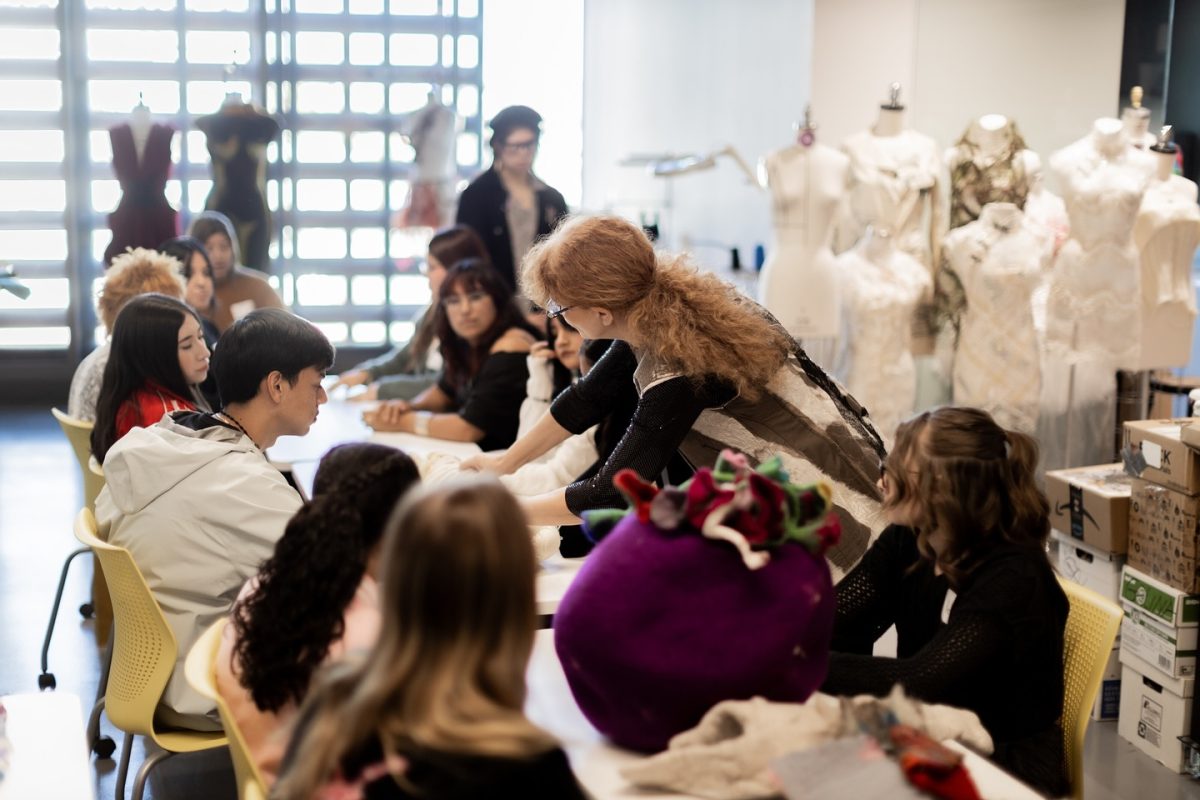
“I work with students, I work with faculty, and I work with the fashion industry; those are the three sort of big branches that I am working with every single day. In terms of my title, it is ‘Assistant Director of Student Success and Curriculum,’ so with that, it’s my effort and energy to make students successful when they come to school here (at ASU FIDM). So that is working with them, providing them resources, making sure that the campus has access to different educational aspects. I work with faculty to make sure that our curriculum is on point to what the industry needs, and then with the industry, I team up with different brands to figure out what they are looking for in graduates from our institution, and then we update our curriculum with that because the industry is changing really quickly, so we also have to change our curriculum.
For example, we were seeing that different employers were asking for virtual reality—not as a requirement, but they wanted that experience—so we were like, ‘Let’s add this to our curriculum.’ So now we have implemented classes in virtual reality design, and we have also created a certificate, so if students take three classes in virtual reality, they are certified by real software and they are ahead of the game.
So, what I do every day—I’m here, I’m around campus, I greet people, I greet employers, I work, I teach, I work with students in connecting them to careers, and then making sure that our curriculum is top-notch.”
Q: Can you tell me about your work in product development?
A:
“So, Legacy FIDM—this was a school before, it closed in 2023—but this school had a degree. They had fashion design, they had merchandising, but there was product development, and so I was the director for the product development major as well as the technical design. I did two, so I did product development and technical design majors, which are different than fashion design and they are different than merchandising.
They’re kind of a mix of both of them together. The product development students and people who go into product development for apparel and fashion are really the designers that are out there. They design the clothes that we regular people wear. Product developers are the ones who design t-shirts, graphic designs, jeans—like all of those things that you buy at the store, the mass market.
Fashion designers might also go into product development. If you’re good at product development, then you’ll be a great designer—that’s how I feel. And if you know how to work with merchandisers—merchandisers are really looking at the business of fashion—a product developer knows how to make money out of a garment, how to make it factory-friendly, how to get the best cost, how to make sure the fit is correct.
So when a customer goes to a store—it’s probably happened to you—when you buy a shirt or a dress and you love the way that it fits and it’s your favorite shirt, and then you go back to that store and you buy a shirt that’s similar, so they build customer loyalty. Having a good fit, having a good price—a product developer is very conscious of that, right? So that’s what I did; it’s a different focus.”
Q: Can you tell me where and what you’ve worked in?
A:
“I started my career—I went to FIDM, and then I graduated in 2008, and so it was a very difficult time then in LA because it was the recession. There were a lot of businesses that were closing, and there weren’t a lot of job opportunities for graduates across all industries, right.
But I got a job, and I was a good student. I got my first job as an assistant to a designer, or an assistant designer, and I was at a maternity and kidswear company. I wanted to be a menswear designer. I wanted to design leather jackets, tailoring, and shirts, and I wanted to do the complete opposite, right. But because I was good at product development and knew the cycle and knew market week and knew Excel, that’s what got me into that route.
So I became an assistant designer, did that for two years, and then after that, I moved to a bigger company called Cerrie Amber Intimates. The first job was tiny—it was like four of us—but this was bigger; there were maybe like twenty to thirty people there. I started off as a production coordinator—that was my title—and so I took care of accounts where we did the designing and manufacturing for brands that were at the mall.
These brands don’t exist anymore—it was like Wet Seal, Forever 21, Charlotte Russe—everything that was at the mall in those little shops. So we did some of their products; that was intimate apparel. And I liked it—I liked it a lot because it was very fast-paced, there were a lot of big numbers.
And then one day in the office, because the company owned a couple of brands, they were doing photoshoots on models, and they said, ‘Can you help on the photoshoot? We’re low in staff.’ And all those things involved in photoshoots cost money. At the maternity company, I had done that already because it was a tiny company, so I said, ‘Totally, I can help with the photoshoot.’
And I loved it. I really liked working on the photoshoot. I brought in a lot of energy, it was a fun day, but also the pictures looked really good because everyone was having a good time, and I knew product. It wasn’t about the picture being a pretty picture—it was like how and where was the picture going to live. Was it going to be online? And you have like one millisecond to see the product and make sure that it looks good, right, so you knew the product had to look good.
So my boss at the time goes, ‘You’re good at this, can you be in charge of the next photoshoot?’ And I said absolutely, and then that led me to be the creative director of the company. I was a designer and a creative director—I had to do both. It happened pretty quickly, within a year, and I really loved it. They say you really cut your teeth in the industry because I was there for seven years.
Then I left the company to another intimate apparel company called Dora L International, and they owned the brand Curvy Couture. It was full-figure garments and shapewear, and it was a lot of engineering and innovation. I got to travel for work—I was in Shanghai, Hong Kong, and Paris two or three times a year, going to design, working with factories, or going to textile shows.
In 2017, I started teaching, but I was still working full-time. I worked as a creative director/designer, and then I would teach one class at night, one day a week. So Tuesday was really long—I was at the office from 8 a.m. to 6 p.m., then I’d drive downtown and teach from 7 to 10 p.m., get home at 11 p.m., and then the next day be back at the office at 8 a.m.
It was a really long day, but I ended up really loving it. I liked it a lot, and I was able to show students real-world work. Sometimes in class it’s a lot of theory, but I could show them, like, ‘Here’s the mood board I made last week.’ And they’d realize they were doing real industry work.
So I started teaching, and then an opportunity came up with FIDM to become creative director, and then we moved over to ASU FIDM.”
Q: Can you tell me about your personal education at both UC Riverside and FIDM?
A:
“I am first generation in my family. My parents are immigrants, and I’m the first American in my family. So navigating the world, there was this—not pressure—but this expectation that I was going to go to university. I was the first person in my family to graduate high school.
So I went to university—I went to UC Riverside, where I majored in Literature and History. I have a Bachelor of Arts in Literature and History. I was going to be a high school teacher.
When I was growing up, my teachers were my role models. I mean my parents too, but my teachers were my professional role models because they had degrees, and they went to university, and I saw them every day. So I wanted to be like them, dress nice, and have what my dad called ‘a clean job.’
So I went to university to be a high school teacher, and then I was ready to start teaching. I remember it was 2007–2008, and like I mentioned earlier, there was a recession. And guess what? There were no job opportunities for teachers. There was a hiring freeze—can you imagine that?
Right now, we need so many teachers, but back then there were no opportunities. So I said, ‘What am I going to do?’
That’s when I went to fashion school because I wanted to. I had a creative side in me, but I didn’t know how to sketch, and I didn’t know how the business worked, but I was fascinated by fashion.
Actually, when I was getting my bachelor’s degree, I studied abroad in Vietnam, and there was a small shop near our dorms. At that shop, you could show them pictures from a magazine, give them your measurements, and they would make it for you. I thought that was so cool.
I got shorts made, but I had an idea for these crazy pants. I couldn’t sketch it, I couldn’t pick the right fabric, and we tried to make something, but it didn’t come out exactly how I wanted. Still, I had fun doing it, and I thought, ‘I need to learn how to do this.’
So when I graduated and there were no teaching jobs, I decided to take a year and do a fashion degree. I ended up doing a degree in product development—and now I teach fashion.”
Q: What eventually led you to want to work with students and especially in student support?
A:
“There’s so much to this because this industry is always changing. I remember when I was going to fashion school, there weren’t many people that looked like me in the industry or had names like mine in leadership roles. There were very few of us.
So I always wanted to make people feel like they belonged there. There’s room for everyone in this industry because we all buy clothes, right? There are different markets, different perspectives, different designs, and different aesthetics.
It’s not just a few people making decisions—there are many of us shaping the industry. So after working in it, I wanted to come back and make sure everyone knows there is a place for them if they really want it.
That’s one of the values I bring into my work. I also just enjoy seeing people succeed. I like helping students do well, and I like being the person who connects people together.”
Q: How would you personally define creative industries? What kinds of careers are included?
A:
“The creative industry is very broad. Obviously, fashion is a big part of it, but creative industries include anything related to design—car design, architecture, interiors, environments, and events.
It’s also entertainment, especially in a place like LA. Everything from TV production to film production and all the different roles involved—costume designers, lighting, actors, editors—those are all part of the creative industry.
These industries also reflect society. The shows we watch entertain us, but they also say something about the time we live in or the world we imagine.
It’s also music—from classical to rap to even kids’ music. All of these creative talents can now become careers. If your passion is playing an instrument, designing clothes, or sketching, there are opportunities out there.
Technology is also becoming a big part of it. Gaming, app development, and virtual reality are all growing areas. For example, gaming companies now want fashion designers to design clothing for avatars. Brands are even selling digital fashion.
These jobs didn’t exist a few years ago, and now they do. Everything is becoming more connected, and different creative fields are starting to work together.”
Q: How can students in creative programs learn to combine creativity with business fields?
A:
“I think a designer also has to be a good business person. If you’re only designing things because they look nice, that’s great—but if you’re not making money from it, it becomes more of a hobby.
We live in a world where you have to understand how to support your creativity financially if you want to turn it into a career.
A strong designer creates something unique and eye-catching, but also something that serves a purpose. Good design is a solution.
For example, you might create a bold, attention-grabbing piece that brings people into your brand, but not everyone will buy that piece. So you also need to offer more wearable, everyday items like t-shirts or jeans.
If you only sell one type of product, you limit your audience. But if you offer variety, more people can connect with your brand.
Design is also about emotion and memory. It could be something someone wears to an important event, like a wedding, and that becomes part of their life story.
So designers need to think about both creativity and business—what makes their brand unique, but also what will actually sell.”
Q: For students who want to pursue creative careers, how can they decide what’s best for them?
A:
“At FIDM, we build skills over time, but we also help students figure out who they want to be. There are so many career paths, not just fashion designer or creative director.
We encourage students to research careers, understand salaries, and explore different opportunities. We also bring in guest speakers from the industry—some are CEOs, and some are recent graduates—so students can see different paths.
There’s no single path to success. Everyone’s journey is different, and it changes over time.
One of the most important things is networking—getting to know people and asking questions. That curiosity and willingness to learn will help you in any industry.”
Q: How do you think students have changed over the years? Is there more competition now?
A:
“The industry has changed a lot. For example, when I was a student, 3D design didn’t exist. So students today are learning different technical skills.
But the most important qualities haven’t changed. Skills like leadership, teamwork, being on time, staying curious, and being willing to learn are always important.
Technology will continue to evolve, so students need to adapt to it. But at the end of the day, curiosity and a strong work ethic will always matter.”