

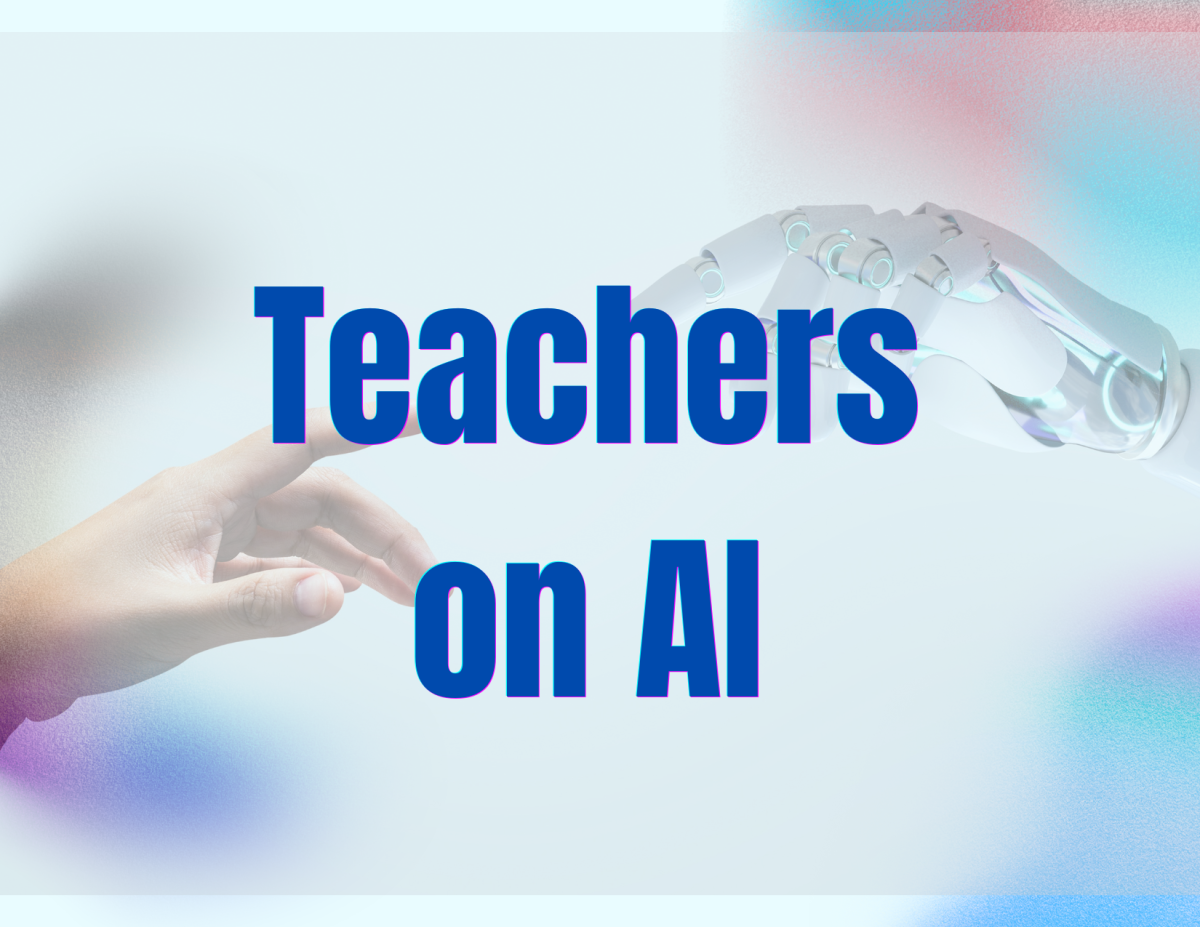









Artificial intelligence has been infiltrating our classrooms and remodeling the way we learn. Many students are beginning to embrace this new technology, while others are more wary of the costs. Many students find AI as a great tool, however, it is important to consider that most tools are not also agents. It is important to contemplate where to draw the line, as AI will soon have no restrictions, and it is up to the user to limit themselves. Teachers are beginning to implement AI scanners as a part of their grading system, like Mr. Polish, who previously used turnitin.com. However, others factor AI into their teacher curriculum resourcefully, like Ms. Ramos. The staff at this school have varying opinions on AI and the extent to which we should adopt it within our learning and personal lives.
Ms. Ramos, the ninth and twelfth grade English teacher, speaks on her stance on AI usage in her professional life. “As a professional, I probably use AI maybe once or twice a week, and that can be for generating quizzes that I don’t have the time to do.” Between balancing a job as an English teacher and going to school for a doctoral degree, there is a lot of paperwork to keep up with, and Ms. Ramos uses AI at times to make the workload easier. However, it is known that AI is not always accurate and so she tries to take it with a grain of salt and fact check it’s work. Typically, Ms. Ramos finds it best for most students to limit their AI usage as they are still developing their critical thinking skills, however, for high school seniors and adults, the lines are more lenient. With the recent increase of data centers in impoverished communities, causing headaches and other neurological problems, Ms. Ramos views the existence of AI as a net negative, “it’s so easy for me and California to use AI in my classroom and not think it’s impacting my environment, but it’s impacting people who live in rural towns with data centers”.
Mr. Polish, on the other hand, believes that AI is not a necessary tool to use, as he does not have ChatGPT or any other AI platforms downloaded. He dislikes the AI overview on Google and urges us to turn it off, as the tool can mistake information and statistics. “I get that there are some legitimate uses of it and I do think it is okay to use to help find articles to answer a question” He said to me, “but if you just look at the answer the majority of time whatever it says in the google answer does not match at all what the article says… the percentage is off, I have to go to the article and read it”. He does not see any reason for students to use AI for any reason other than to find sources to research, but even those can be found simply using the internet (and AI has been found to deliberately lie to researchers already!). Beyond student use of generative technology, Mr. Polish thinks that AI has produced a net negative for a multitude of reasons: “We cannot increase our carbon footprint even minutely… it is making us dumber and more reliant on technology than before”.
On another hand, Mr. Wilkinson tries to use AI very particularly, “It’s kind of infrequent. I would talk to it about ideas to make a list of notes, but I rarely use it to ask questions I don’t know the answer to,” the English teacher said. Wilk mentions that AI frequently answers questions incorrectly or misses the full context, so he prefers to only use it as an organizational tool for his thoughts. However, whether students should or should not use AI is a bigger question that he doesn’t fully know the answer to; he doesn’t think anyone fully does. He importantly mentioned that the larger tech companies are doing everything they can to push AI onto students to make a profit and that “they’ll do anything they can to insert themselves in the thought process of children so they can make money … and they know it’s bad for the children”. Above all, Mr. Wilkinson does not believe that AI is inherently evil– similarly to what Brian Eno said– he is more concerned about the tech giants that are trying to make money off it in an arms race. He expressed the importance of reading about this topic more and understanding the nuances. He also hopes to do more timed writing in class to assess students’ thought processes without the crutch of AI.
With every teacher’s opinion on the usage of AI, it is important for us to consider the positive and negative outcomes of AI. It is a fact that AI is polluting our environment, and the data centers disproportionately affect impoverished communities. However, AI can also be seen as a tool to build us, but if we are not careful, we can easily destroy our own society. Thus far, generative technology has been conducive to some good, but even more abysmal slop. Whether AI is an incorrigible piece of technology and whether all data centers should be immediately razed is currently unknown, however, we have seen what it has done for us so far, and we need to consider what the future will look like with this technology. All the teachers I have interviewed agreed consistently on the fact that AI is not always accurate, and we should not become dependent on it as a tool. If we do not use our cognitive ability, it will degenerate, and we will be vulnerable to the oligarchs who can then take advantage of us. Whether we use AI, it is important to draw individual lines and not let the technology be pushed to us, get anywhere near our personal thought processes.